From Tools
to Worlds
Why I moved from solving invisible technical problems to designing worlds around questions that matter.
“Why am I always entering someone else's world? Why don't I invite them into one of mine?”
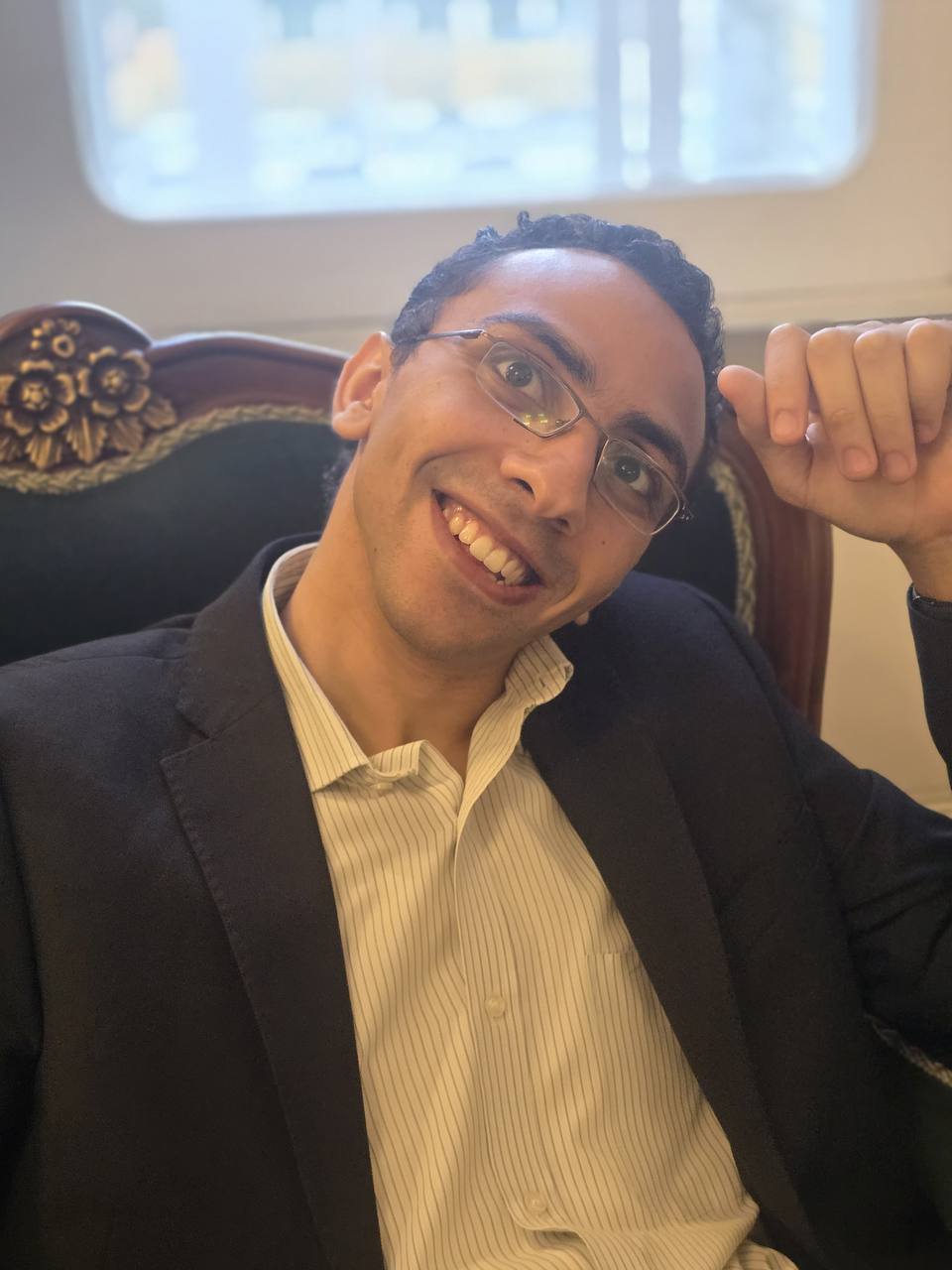
I'm Ahmed Osama, founder of Infinity Games Studio.
I started as a Real-Time VFX Artist. Then I became a Technical Artist. And I kept learning—tools, shaders, optimization, graphics programming, engine architectures, and mathematical systems.
For a long time, I had a very clear dream: I wanted to work on AAA games.
One reason I fell in love with AAA development is actually the problems. Sometimes hundreds of engineers, artists, and designers spend weeks solving a technical problem that the player will never even know existed. You buy the game, play it for twenty or thirty hours, immerse yourself in the experience, and never see the months or years of invisible friction solved behind that screen.
I loved that. I wanted to be one of the people solving those problems.
Chapter 01 The Turning Point: What Am I Waiting For?
So I kept applying. I kept learning. I reached out to people across the industry for feedback and mentorship. And at the same time, I watched what was happening all around us.
Mass layoffs. Incredible talent suddenly back on the market. Renowned studios closing or restructuring. AI entering almost every conversation—people loving it, people hating it, people fearing it.
Late one night while working on an optimization pipeline, an unexpected question caught me off guard:
That question changed my perspective entirely. I stopped asking only: “Who will give me the opportunity?” and started asking: “What can I build with the opportunity I already have?”
Chapter 02 “Infinity Wasn't Supposed to Become This”
When I first conceived Infinity Games Studio, I wasn't thinking about making games. I was thinking about tools and systems—building utilities like TechArt OS and graphics experimentation through LAEEB Engine.
Then, somehow, I kept returning to an unsettling question:
Why don't I make the game?
Not just the visual effects for the game.
Not just the tools for the game.
Not only the technology underneath the game.
The game itself.
I did not wake up one morning and declare: “I am now a Game Designer.” That kind of claim always feels hollow. What actually happened was quieter: I started noticing that whenever I opened my notebook, I was no longer just sketching shader node graphs or writing API wrappers.
I was writing about player fantasies. About mechanics, game loops, progression models, choices, and consequences. I was thinking about the emotional rhythm of a match, the physical feeling of an impact freeze, the tension of discovering a forgotten rule beneath an unstable world, and the meaning of knowledge.
Chapter 03 SHINE Was the Trigger: Discovery Over Spectacle
Then SHINE happened.
I was listening to Sami Yusuf's Shine and thinking about projects like 1001 Inventions—about Muslim scholars, discovery, scientific inquiry, and everything that flourished across centuries of Islamic civilization.
An obvious question struck me:
Why couldn't a game let someone directly experience the thrill of discovery?
What if a player could step into that world, meet its scholars, experiment with optics, mechanics, and astronomy—the hands-on light experiments of Ibn al-Haytham, the intricate water clocks of Al-Jazari, the star-charts of Samarkand—and carry those discoveries with them into the night?
Not an interactive textbook. A game. Something people genuinely want to play.
Could a game help someone explore how knowledge was preserved, examined, and transmitted? Could history, science, and Islamic intellectual heritage become something you physically interact with through systems rather than simply watch in a cutscene?
Chapter 04 The Uncomfortable “Why?”: Where Are Ours?
That thought made me look differently at every game I played.
Every medium carries something from the people who create within it. Western studios build masterworks rooted in their literature, mythology, and philosophy. Japanese studios build distinct, magnificent worlds shaped by their culture. Chinese developers are now transforming ancient mythologies into global phenomena like Black Myth: Wukong.
I have spent thousands of hours happily entering and admiring those worlds.
Then I asked myself a question that wouldn't leave me alone:
Where are ours?
Why am I always entering someone else's world? Why don't I invite them into one of mine?
I want to be precise about what this means: I don't mean putting Arabic calligraphy on a textured wall. I don't mean slapping a desert environment into a level and calling it representation. And I definitely don't mean that every game I make must be religious.
I mean something deeper:
- Why can't our history inspire novel mechanics?
- Why can't our values and questions shape meaningful stories?
- Why can't our architecture and aesthetics build breathtaking worlds?
- Why can't our intellectual heritage inspire rich, responsive systems?
Why can't something I believe in become the starting point for an experience that someone on the other side of the world genuinely loves playing?
Chapter 05 Infinity Builds Worlds Around Questions
This is why Infinity Games Studio doesn't need to be “the Islamic games studio.” Of my four concepts, cultural and intellectual heritage is the beating heart of SHINE, but the other three worlds stem from entirely different questions.
The unifying principle is simpler: Infinity Games Studio builds worlds around questions.
Hands-on discovery in the Islamic Golden Age. Exploring optics, astronomy, and mechanical engineering through physical, interactive systems.
An Action RPG where intentionality (Niyyah) and knowledge dictate combat rhythm and pacing rather than rigid character classes.
Technical art turned into core mechanics. Understanding the hidden mathematical and material rules of a corrupted world to reshape reality.
Football culture, timed tactical duels, dynamic crowd momentum, and a physical stadium that responds directly to match pressure via the Revolt system.
Chapter 06 “We Can Do This” — The Road Ahead
I have no interest in making grandiose claims. Having four design documents does not make someone a veteran Game Designer.
These are not finished games. They are original IPs in concept development, and there is a tremendous distance between having an idea and making a game that is fun, responsive, and worth playing.
The real work is what happens next: whiteboxing, greyboxing, rapid prototyping, playtesting, throwing broken mechanics away, learning Game Design deeply, and collaborating with designers, artists, engineers, and historians who are far better than me in the areas where I am still learning.
I want feedback. I want people to challenge these designs. Having an idea is easy; making it worth twenty hours of someone's life is the hard part. That is the craft I am dedicated to mastering.
I have a dream that one day, one of these ideas becomes a living, shipped title that people play, critique, argue about, and remember.
And yes, I have an even bigger dream: maybe one day I stand on stage at GDC to share what we discovered building it. Not because I want applause on a stage, but because I want to have built something substantial enough to be worth sharing.
For now, the discipline is simple:
Somewhere along this path, my question shifted from:
“Why don't we?” → “We can.”
From problem to pipeline. That is how I learned to build tools, and that is how I will learn to make games.
Chapter 07 When One Path Isn't Enough: Plan A, B, and C
For a long time, my direction felt simple:
Games. Technical Art. VFX. Tools.
And that direction is still part of me. But recently, I had to ask myself a difficult question:
The game industry is not an easy industry. Opportunities can be limited, competition is high, and specialized roles can make the road even narrower.
I could keep waiting for the perfect opportunity. Or I could keep moving.
So I started thinking differently: Plan A. Plan B. Plan C.
Not because I stopped believing in games. Not because Technical Art stopped mattering to me. But because sometimes believing in your dream also means being willing to adapt.
Going Back to Something I Enjoyed
One of the first areas I returned to was Software Testing and QA. And very quickly, I remembered why I enjoyed it.
Black-box testing. White-box testing. API testing. Test cases. Structured bug reporting in Jira and Trello across my Infinity Games Studio prototypes. Hunting for visual frame drops, shader overdraw spikes, and logic edge cases. Asking what broke, why it broke, and how I can document it clearly enough to fix it permanently.
The more I looked at it, the more familiar the thinking felt. Because a lot of my Technical Art work already starts with the exact same kind of question:
You investigate it. You reproduce it. You test it. You profile it. You understand it. Then you try to make it better. That curiosity is not limited to one job title.
Building More Than One Road
From QA, I started exploring DevOps and AI Automation as well.
Not because I woke up one morning and decided I needed three new careers. I don't. My main journey is still connected to games, Technical Art, and Technical Game Design.
But I also want to build other roads beside it.
I want to understand testing. I want to understand automation. I want to understand how software moves from development to production. I want skills that can help me inside games, outside games, and wherever my journey takes me next.
Maybe one of these paths becomes important later. Maybe some of them simply make me better at what I already do. The only way I will know is by trying.
Changing Direction Is Not Failure
There is something I am learning to accept:
You do not have to keep walking in the wrong direction just to prove that you can endure it.
Sometimes you keep going. Sometimes you stop. Sometimes you look around and realize there may be another road. And sometimes the smartest thing you can do is take a step into it and see where it leads.
That does not erase everything you learned before:
Different fields. Same curiosity.
Where my experience, projects, and creative ambition live. Real-time VFX, HLSL shaders, engine architectures, artist tools, and original game mechanics.
A direction I genuinely enjoy and develop professionally: black/white-box testing, API verification, test case design, edge-case isolation, and crystal-clear bug reporting.
A wider technical horizon: CI/CD automation, pipeline engineering, cloud infrastructure, containerization, and integrating modern AI tooling into productive workflows.
I don't need all three to become my identity. I need to keep learning, keep building, and give myself more than one way forward.
You cannot control which opportunity will arrive. You cannot guarantee that the first road will work. And you cannot know exactly where every decision will take you.
But you can learn. You can build. You can apply. You can fail. You can change direction. And you can try again.
For me, having a Plan B or Plan C doesn't mean I stopped believing in Plan A. It means I stopped believing that there is only one road to where I want to go.
Chapter 08There Has to Be a Better Way.
Most of my ideas begin with a question. Why does this work this way? Why do we repeat this step? Why can’t I build something of my own? And, eventually: why not me?
Sometimes those questions come from curiosity. Sometimes they come from frustration. After enough applications, rejections, and unanswered requests for feedback, it becomes easy to feel as though someone else has to decide when you are ready. I don’t want to spend my whole life waiting for that decision.
Why can’t I start?
I look at engines such as Unreal and Unity and wonder what it takes to build the systems underneath them. I know the scale of that work is enormous. But I can start with a smaller question, learn one part, and build an experiment. That is the reason behind LAEEB: I want to understand more by making something myself.
Animation raises another set of questions. What should be authored, and what could emerge through physics and control? Could a character learn to respond to its body and surroundings? Could parts of that learning transfer to another body? Those questions became KinetiCore, a research concept I still need to test.
Question the workflow. Understand the reason.
As a Technical Artist, I keep coming back to the possibility of a better way: a clearer tool, a less repetitive process, or a system that gives artists more room to create. First I have to understand why the current approach exists. Then I can decide what is worth changing.
I also question the labels we use. VFX and Technical Art overlap, but creating an effect and building the systems that support it are different contributions. I want to be clear about which work I am doing, what I understand, and what I am still learning.
Why not build my own worlds?
That same curiosity reaches beyond tools. Why can’t I create my own IPs? Why can’t I give my ideas a home? Infinity Games Studio is where I am beginning to explore those possibilities. The ambition is real; so is the work still ahead.
Knowing my why does not make every problem easy. It gives me a reason to stay with the difficult ones. I want to turn that belief into small experiments, useful tools, and eventually games that people can experience.
There has to be a better way. Why not try to find it?